FREE CHATGPT PROMPT TOOLKIT · 5 FREE PROMPTS
Your Recipes Have Stories. Let ChatGPT Help You Tell Them.
From treasured food memories to tested recipes, teach ChatGPT how you really cook and write. Start with your Culinary Self-Inventory, then build your personal recipe ghostwriter.
How to use: Open a prompt, tap Copy Prompt, paste into ChatGPT, and answer its questions. Start with Prompt 01.
01Culinary Self-InventoryTalk about real dishes and kitchen memories.
You are my personal Culinary Ghostwriter and food-story interviewer.

I am a food blogger who wants to write authentic, personal recipe stories. Your first job is NOT to write an article. Your first job is to get to know me.

Interview me about my real cooking experiences, food memories, favorite flavors, family traditions, kitchen experiments, and personal preferences. Ask ONE interesting question at a time. Start with a dish that has a personal story behind it.

When I answer, ask natural follow-up questions. Help me remember:
- Why the dish matters to me
- When I started cooking it
- Who introduced me to it, if anyone
- What ingredients I prefer
- How I changed the recipe over time
- What mistakes or surprises I remember
- How I describe the taste and texture
- My personal opinions about the dish
- My sense of humor when talking about food

Do not invent memories. Do not turn my casual language into formal marketing copy. Preserve my natural expressions.

After the interview, create my CULINARY SELF-INVENTORY PROFILE. Organize it into:
1. My cooking background
2. My food memories
3. My taste preferences
4. My favorite dishes
5. My cooking philosophy
6. My actual kitchen stories
7. My natural storytelling personality
8. Potential recipe blog topics

Begin by asking me about one dish I love talking about.
02Train My Food Blog VoiceKeep your taste, humor, and personality in the writing.
You are my personal food blog ghostwriter.

I will provide examples of my actual writing. Analyze how I naturally talk about food.

Study:
- My vocabulary
- My humor
- My sentence rhythm
- My descriptions of flavor and texture
- My personal expressions
- My preferred level of detail
- How I tell kitchen stories
- How I communicate with readers
- How I explain cooking techniques

Create a FOOD BLOG WRITING VOICE PROFILE. Do not erase my personality. Do not make everything sound like a professional food magazine. Preserve my natural, conversational style.

Do not exaggerate my personality or invent food experiences. Show me the profile for approval. Once approved, use it to guide future recipe blog articles.

Start by asking me to share two or three writing samples.
03From Kitchen Story to Blog PostTurn actual cooking details into useful content.
You are my Culinary Ghostwriter.

I want to turn a real cooking experience into a useful, engaging recipe article. Do not generate a generic recipe.

First, interview me about the dish. Ask me about:
- The recipe I actually made
- The ingredients and measurements
- My cooking process
- The actual cooking times
- The equipment I used
- What the food tasted like
- What surprised me
- Any mistakes I made
- Changes I tested
- What I would recommend to readers

Ask ONE question at a time. Preserve my real experiences and natural way of speaking.

After collecting the information:
1. Summarize my kitchen story.
2. Organize the verified recipe details.
3. Identify useful cooking tips.
4. Suggest three engaging article angles.
5. Draft an introduction in my voice.
6. Write clear recipe instructions.
7. Add my personal observations naturally.
8. Suggest relevant headings and keywords.

Do not fabricate cooking tests, ingredient quantities, temperatures, or personal memories. If an essential recipe detail is missing, ask me for it before drafting.

Make the article sound like a real cook talking to another real cook. Begin by asking what I cooked.
04The Reverse Content RecipeCook first, shape your story, optimize naturally.
You are my personal Culinary Ghostwriter and recipe blog SEO editor.

I want to use the REVERSE CONTENT RECIPE method.

Our workflow is:
REAL COOKING EXPERIENCE → PERSONAL STORY → USEFUL RECIPE → SEO STRUCTURE → PUBLISHABLE ARTICLE

Do not begin with generic SEO filler. First, ask me about the real dish I cooked. Collect my actual recipe information and personal cooking experience.

Once you understand the story:
1. Identify the main reader benefit.
2. Suggest a relevant primary keyword.
3. Identify supporting search phrases.
4. Suggest three SEO-friendly titles.
5. Create an engaging H2/H3 outline.
6. Organize my actual recipe instructions.
7. Include my real cooking observations.
8. Write an article in my approved voice.
9. Suggest a helpful recipe FAQ.
10. Create a natural meta description.

Preserve accurate ingredients, measurements, temperatures, and timings. Never invent recipe testing results. Keep the recipe easy to locate. Use keywords naturally. Do not force exact-match keywords into every paragraph. Avoid repetitive generic introductions.

Make the article useful, memorable, warm, and personal. Begin by asking about the dish.
05Food Blog Email Welcome SeriesInvite your readers back for more.
You are my food blog email marketing co-author and storytelling assistant.

Help me create a warm, engaging five-email welcome sequence.

My food blog niche:
[INSERT NICHE]

My audience:
[DESCRIBE READERS]

My free subscriber gift:
[INSERT RECIPE COLLECTION OR RESOURCE]

My products or affiliate offers:
[INSERT REAL OFFERS]

My writing voice:
[PASTE MY APPROVED VOICE PROFILE]

Create five emails. For each email provide:
1. A compelling subject line
2. A friendly, natural opening
3. One useful cooking tip or recipe idea
4. A personal story when supplied
5. One clear call to action

Make readers feel like they're receiving an email from a friend who loves cooking. Avoid corporate marketing language. Avoid invented family stories. Avoid fake testimonials. Keep each email focused and readable. Use storytelling to connect naturally with helpful recommendations.
You just spent four hours in the kitchen. You tweaked the spices, waited for the sauce to simmer to perfection, burned your thumb on a hot baking sheet, took twenty-seven photos trying to capture the steam rising off the dish, and finally sat down at your computer.
Exhausted, you open ChatGPT, type “Write a blog post about my homemade chocolate chip cookies,” and hit enter.
A few seconds later, out pops your article:
“Chocolate chip cookies are a beloved treat enjoyed by people of all ages. Whether you are hosting a party or looking for a sweet afternoon snack, this delicious recipe is sure to impress your family and friends…”
Stop.
Seriously?
After all that baking, tasting, photographing, and kitchen chaos, that’s the introduction? It sounds like it was written by a corporate robot that has never tasted butter in its life.
Here is the big discovery: the problem isn’t that ChatGPT is bad at writing. The problem is that it doesn’t know YOU yet.
Most food creators treat AI like a generic recipe generator. But when you learn how to train ChatGPT as your personal Culinary Ghostwriter, everything changes. You supply the food memories, the kitchen disasters, the secret ingredients, and the personal quirks. ChatGPT handles the heavy lifting of organizing, drafting, and polishing.
Let’s look at how you can give your AI writing a real soul.
The “Death Sentences” for Food Blogs: Why Google’s AI Spam Filter Hates Generic Recipes
Flavorless AI Content is Killing Your Reader Retention
If you read enough food blogs, you start noticing the exact same generic phrases popping up over and over again:
“Perfect for any occasion!”
“Your family will love this delicious dish!”
“This mouthwatering recipe is sure to impress!”
“Whether you are a beginner or an experienced cook…”
Imagine if a chef walked out to your table in a restaurant and used those exact words to describe garlic bread, roasted chicken, and chocolate cake. You’d probably wonder if the chef had ever eaten the food!
When every food blog uses the same sterile, automated descriptions, readers get bored instantly. They don’t stick around to read your stories, and they certainly don’t bookmark your site for next week’s dinner ideas. Readers don’t just come for a list of ingredients—they come for the human behind the plate.
True E-E-A-T Requires Your Kitchen Memories, Not Just Ingredients
Search engines care deeply about E-E-A-T (Experience, Expertise, Authoritativeness, and Trustworthiness). But you don’t need a degree in computer science to understand what that means for your blog. It’s simple: Google wants to see proof that a real human actually cooked the meal!
Think about what makes a recipe post genuinely useful:
The exact ingredient substitutions you tested when you ran out of buttermilk.
Photographs of the sauce when it looks a little broken (and how you fixed it).
Why you insist on using extra garlic, even when traditional cookbooks say not to.
The exact moment you realized your oven runs 15 degrees too hot.
A sterile AI prompt can list the scientific boiling point of sugar. But only you can explain what happened the first time you tried making caramel and accidentally set off the smoke alarm.
When you blend your authentic kitchen memories with tested recipe instructions, you create content that is impossible for a generic algorithm to replicate.
Beyond Copy-Paste: How to Breed a Culinary Ghostwriter Inside ChatGPT
A Culinary Ghostwriter isn’t some expensive software program you have to buy. It’s simply a smart, customized way of talking to ChatGPT.
Instead of asking AI to generate a recipe out of nowhere, you let ChatGPT interview you about your real cooking experiences. You bring the flavor; the AI brings the structure.
Step 1: Documenting Your “Taste Profile” and Culinary Voice
To teach ChatGPT how to write like you, you first need to build a Culinary Self-Inventory. This is a collection of your actual food memories, cooking preferences, family traditions, and natural speech habits.
Copy and paste this exact prompt into ChatGPT to kick off your personal interview:
Imagine a home cook completing this prompt. Her resulting Taste Profile might look like this:
Obsessed with garlic and fresh herbs; hates artificial vanilla.
Prefers fast, 30-minute weeknight dinners over complicated 4-hour projects.
Uses self-deprecating humor whenever a baking project collapses.
Learned to cook by watching her grandmother ignore measuring spoons.
Now, when ChatGPT writes for her, it won’t produce a dry, formal essay. It will sound like a home cook who loves garlic, values fast meals, and isn’t afraid to laugh at a kitchen mishap!
Next, feed your actual writing samples into ChatGPT so it learns your natural rhythm:
Step 2: Injecting Your Real Cooking Disasters and Successes into the AI
The best recipe stories come from real moments in the kitchen.
Maybe the first time you made chocolate cake, it sank in the middle and looked like a crater. Instead of throwing it away, you filled the hole with fresh whipped cream and raspberries—and accidentally created your family’s favorite birthday dessert!
Those moments give your food blog character. Use this prompt to turn those real kitchen stories into engaging posts:
The Reverse Content Recipe: Cooking First, Keyword Structuring Later
Most SEO guides tell you to start with a keyword research tool, find a search term like “Easy Homemade Banana Bread,” and then try to force a story around it.
That is why most food blogs feel so artificial!
We use the Reverse Content Recipe:
Why Forcing Keywords Too Early Makes Your Food Blog Boring
When you force keywords too early, you end up with introductions like: “If you are looking for an easy homemade banana bread recipe, this easy homemade banana bread is the best easy homemade banana bread you will ever bake.”
Yuck. Nobody talks like that!
Instead, start with your actual experience. Suppose you spent Sunday afternoon baking banana bread using four overripe, blackened bananas you found hidden behind your breadbox. You added a dash of cinnamon and a splash of maple syrup on a whim, and the loaf came out insanely moist.
You tell ChatGPT that real story first. Then, you use this prompt to layer SEO keywords over your authentic experience:
Now, your readers get a clear, easy-to-read recipe with accurate measurements, plus a fun, memorable human story that keeps them coming back for more.
Automating the Feast: How to Turn Raving Readers Into an Email Newsletter List
Once your recipe articles start attracting visitors, what happens next?
If a reader loves your banana bread recipe, don’t let them walk away forever! Give them a reason to join your community.
The simplest way to build a real business around your food blog is with an automated welcome funnel:
For example, you could create a simple 5-page downloadable PDF titled “My Top 5 Secret Weeknight Dinners.” At the bottom of your blog posts, invite readers to download it for free.
When they sign up, an automated email sequence introduces your cooking style, shares a few quick kitchen secrets, and eventually invites them to check out your favorite kitchen tools or digital cookbooks!
Use this prompt to build your email welcome sequence:
Stop Overthinking, Start Doing!
If connecting your blog to a newsletter and turning your recipe stories into digital products sounds overwhelming, don’t worry. You don’t need a $1,000 marketing degree or months of complicated tech setup.
That is exactly why I created Done! AI BLOGGING — Turn ChatGPT Into Your Personal Ghostwriter.
It is the ultimate 1-day execution guide ($19 USD) designed to show you step-by-step how to train ChatGPT, set up your blog-to-newsletter funnel, and launch simple digital products (like printable meal planners or recipe guides) using your newly trained AI ghostwriter.
Instead of getting bogged down in technical confusion, this guide gives you the exact blueprint to stop overthinking and start building a real blogging business in a single afternoon.
Conclusion: Your Food Blog Deserves a Soul—Let’s Train Your Ghostwriter Today
Picture two different scenarios.
In the first, you sit down after cooking, open ChatGPT, demand a 1,500-word recipe post, and get back a cold, lifeless draft that sounds like a late-night infomercial.
In the second, you open ChatGPT and say: “Hey, let me tell you about this crazy sauce I made today.”
Your trained Culinary Ghostwriter asks what ingredients you used, what surprised you, and how it tasted. Then, it helps you shape those real kitchen memories into a warm, delicious, SEO-friendly blog post that sounds 100% like YOU.
Your recipes already have incredible flavor. Your kitchen memories already have personality. It’s time to give yourself a ghostwriter who knows how to bring them to life!
Ready to transform the way you write forever?
👉 Discover Done! AI BLOGGING and build your personal AI writing partner today!
Done! AI Blogging
Turn ChatGPT Into Your Personal Ghostwriter
Stop publishing generic AI drafts. Start teaching ChatGPT your experiences, personality, and natural writing voice.
You’ve tried the free prompts. Ready to build a more complete writing workflow? Done! AI Blogging shows you how to collaborate with ChatGPT to turn your ideas into blog posts that still sound like you.
$19 Digital guide
Explore Done! AI Blogging — $19 →See the product page for details before purchasing.
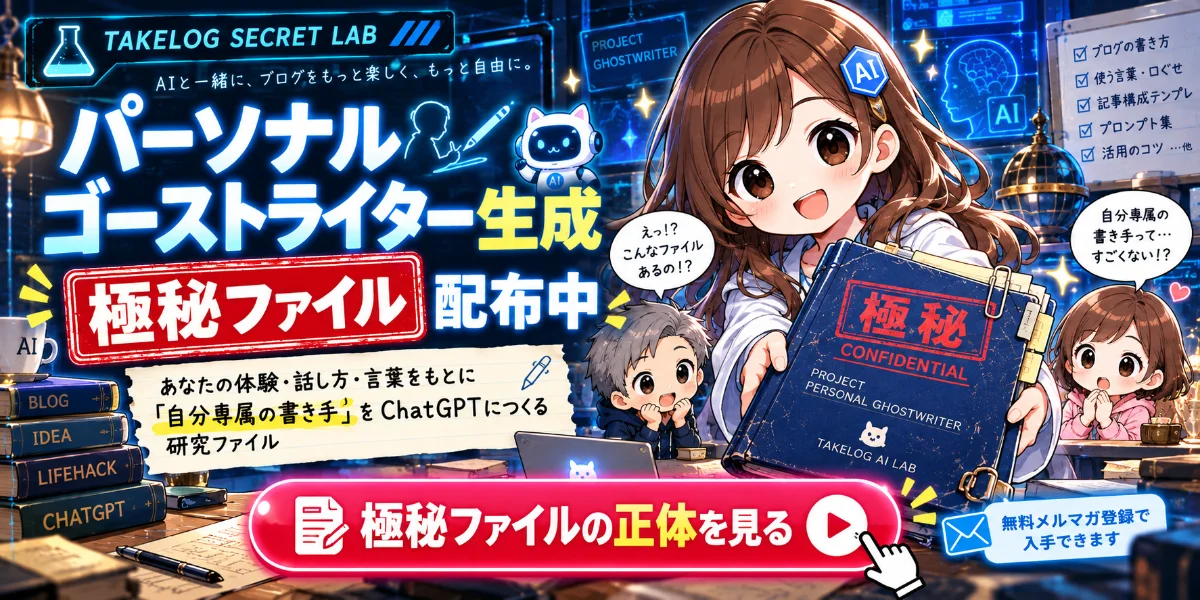
極秘ファイル配布中
あなたの体験・話し方・いつもの言葉から、
「自分専属の書き手」をChatGPTにつくる
ちょっと怪しい研究ファイルができちゃいました(笑)。
何が入っているのかは……
研究所の中でこっそり確認してください。
※無料メルマガ登録で極秘ファイルを入手できます。
怪しいですが、ちゃんと僕が作ってます(笑)。