FREE CHATGPT PROMPT TOOLKIT · 4 FREE PROMPTS
Your Fandom Has a Voice. Let ChatGPT Learn It.
Your favorite comeback deserves more than a bland AI recap. Capture your real reactions, opinions, and memories—then teach ChatGPT how to write with your energy.
How to use: Open a prompt, tap Copy Prompt, paste into ChatGPT, and answer its questions. Start with Prompt 01.
01Build Your Fandom BlueprintGive ChatGPT the real story behind your fandom.
You are my personal Fandom Ghostwriter and K-pop story interviewer.

I want you to understand my real personality as a music fan before writing blog articles. Do not write an article yet.

Interview me ONE question at a time. Learn about:
1. My favorite K-pop groups and artists
2. How I discovered them
3. My bias and favorite members
4. My favorite songs and albums
5. My favorite performances
6. My actual concert experiences
7. My reactions to different comebacks
8. My opinions about music and choreography
9. My funniest or most memorable fan moments
10. My natural way of talking about music

Ask interesting follow-up questions. Encourage me to speak naturally. Preserve my enthusiasm, opinions, humor, and unusual expressions.

Do not invent concerts, memories, emotions, or artist interactions.

After our interview, create a FANDOM BLUEPRINT that includes:
- My fandom background
- My favorite artists
- My music preferences
- My strongest opinions
- My memorable experiences
- My storytelling style
- My recurring expressions
- Potential fan blog topics

Begin by asking which artist or group first made me fall in love with K-pop.
02Train My Fandom VoiceCapture real excitement without fake hype.
You are my personal K-pop fan blog ghostwriter.

I will share examples of my real writing. Study my natural communication style.

Analyze:
- My vocabulary
- My humor
- My emotional expressions
- My sentence rhythm
- How I describe performances
- How I express excitement
- How I discuss my favorite members
- How I compare songs and albums
- How I share opinions
- How I address other fans

Create my FANDOM WRITING VOICE PROFILE. Preserve my genuine personality. Do not make my writing sound like a record-label press release. Do not exaggerate my excitement. Do not insert random slang, emojis, or exclamation marks to imitate fandom.

Never invent personal experiences. Show me the completed voice profile. Ask me to approve or correct it. After approval, use the profile when helping draft my articles.

Begin by asking for two or three samples of my actual writing.
03Reverse Fandom StrategyReact first, research and optimize second.
You are my personal Fandom Ghostwriter and entertainment blog SEO assistant.

I want to write a K-pop fan blog article using the REVERSE FANDOM STRATEGY.

Our workflow is:
MY REACTION → MY OPINIONS → OUR CONVERSATION → ARTICLE ANGLE → SEO KEYWORDS → FINISHED BLOG POST

Do not generate a generic news summary. First, ask what happened in the K-pop world that I want to discuss. Then interview me ONE question at a time.

Help me explain:
- What caught my attention
- Why I care about it
- What I noticed
- My actual reactions
- My interpretation
- My relevant past experiences
- What other fans might find interesting

Do not invent my feelings or experiences. Do not present speculation as confirmed news.

After our conversation:
1. Summarize my authentic opinions.
2. Identify the strongest article angle.
3. Suggest relevant SEO keywords.
4. Suggest three clickable article titles.
5. Create an H2/H3 outline.
6. Draft the article in my approved voice.
7. Separate verified facts from fan theories.
8. Suggest a natural ending that invites discussion.

Avoid robotic K-pop journalism. Do not copy official articles. Do not create fake quotes from idols. Do not fabricate fan reactions.

Begin by asking what I want to talk about.
04Build Your Fan NewsletterKeep the conversation going after the article.
You are my personal K-pop fan newsletter writer and email marketing co-author.

Help me build an engaging email sequence for readers who enjoy my music blog.

My blog niche:
[INSERT NICHE]

My favorite artists:
[INSERT ARTISTS]

My audience:
[DESCRIBE READERS]

My free subscriber gift:
[INSERT ORIGINAL RESOURCE]

My real affiliate or digital products:
[INSERT OFFERS]

My approved writing voice:
[PASTE VOICE PROFILE]

Create a five-email welcome sequence. For each email include:
1. A compelling subject line
2. An engaging opening
3. One useful fan-related topic
4. My real opinions when supplied
5. A natural call to action

Make the emails sound like messages from a passionate fellow music fan. Do not invent concert stories. Do not invent artist quotes. Do not claim personal connections to performers. Avoid corporate marketing language. Invite genuine conversations with subscribers. Make the experience feel like joining a friendly fan community.
You’re watching your favorite group’s brand-new music video the exact second it drops. You notice a tiny detail in the choreography at the 1:42 mark—a subtle callback to a dance move from their debut era three years ago. Your mind starts racing with theories, opinions, and pure excitement.
You open ChatGPT to write a blog post about it. You type: “Write a review of the new K-pop music video.”
And ChatGPT hits you with this masterpiece:
“This talented K-pop group has captivated global audiences with their impressive performances and musical versatility in their latest release.”
Seriously?
THAT is what the AI came up with?
Where’s the hype? Where’s the hot take? Where’s the fan who has been replaying the same five seconds of the music video for the last twenty minutes?
When you ask AI to write about something you love without giving it any direction, it talks like a record label’s PR department. But here’s the good news: you don’t have to choose between spending four hours writing every word by hand or publishing soulless, corporate AI fluff.
You can teach ChatGPT to become your personal Fandom Ghostwriter. You supply the passion, the memories, the concert tears, and the wild theories. ChatGPT helps shape all that chaotic fan energy into readable, searchable, engaging blog posts that sound 100% like YOU.
The Fan Blog Dilemma: Why Copy-Pasting Official K-Pop News is Freezing Your Traffic
Google’s E-E-A-T Wants Your Obsession, Not a Wikipedia Summary
Let’s be real about entertainment blogging and music blog SEO. If your entire strategy consists of copying official press releases or rewriting news headlines, why would anyone visit your blog?
Look at the difference:
- Official Press Release Copy: “The popular group has announced a new album and world tour, delighting fans worldwide.”
- Authentic Fan Perspective: “I was honestly expecting a dark concept after their last comeback, so when the bright synth-pop teaser dropped, my jaw hit the floor. The line distribution in the highlight medley already looks way fairer this time around…”
The first example is dead weight. Anyone—and any basic AI—can churn that out in two seconds. The second example has a voice, a memory, and a real opinion.
Search engines evaluate content using E-E-A-T (Experience, Expertise, Authoritativeness, and Trustworthiness). When you share firsthand concert observations, album comparisons, original photos, or deep-dive analysis into a group’s lore, you’re giving searchers something an automated news aggregator can’t match: actual human experience.
Why a Soulless AI Output Can Never Connect with Real Fandoms
If you’ve spent any time reading AI-generated entertainment blogs, you’ve seen these exact sentences a thousand times:
- “This highly anticipated comeback showcases the group’s incredible versatility…”
- “Fans around the world are buzzing with excitement…”
- “The members continue to captivate audiences with their exceptional talent…”
It’s exhausting. K-pop fans don’t talk like that!
Real fans care about the fact that your ult bias finally got center time in the dance break. They care about the acoustic arrangement from last night’s encore stage, or how a new title track compares to a legendary 2018 B-side.
Generic AI writing strips away the very thing that makes fan blogs fun: the personality. But what if your ChatGPT actually understood why you care about these artists in the first place?
From Robot to Stan: How to Inject Your Pure Passion Into ChatGPT
To humanize AI content for your fan blog, you need to build what I call a Fandom Blueprint.
Instead of treating ChatGPT like an automated essay generator, you treat it like a fellow fan who is interviewing you for a zine. You supply your history, your biases, and your hot takes, turning ChatGPT into an AI ghostwriter that understands your fandom DNA.
Step 1: Feeding Your “Fandom Blueprint” (Your Biases, Concert Tears, and Hot Takes)
Before you ask ChatGPT to draft an article, let it interview you about your relationship with music.
Who are your ult groups? When did you fall down the rabbit hole? What was the first comeback you experienced in real time? What’s an opinion you have that would start a friendly debate on Stan Twitter?
Copy and paste this prompt into ChatGPT to get started:
Plaintext
COPY-AND-PASTE PROMPT #1 — MY FANDOM BLUEPRINT

You are my personal Fandom Ghostwriter and K-pop story interviewer. I want you to understand my real personality as a music fan before writing blog articles.

Do not write an article yet. Interview me ONE question at a time. Learn about:

1. My favorite K-pop groups and artists
2. How I discovered them
3. My bias and favorite members
4. My favorite songs and albums
5. My favorite performances
6. My actual concert experiences
7. My reactions to different comebacks
8. My opinions about music and choreography
9. My funniest or most memorable fan moments
10. My natural way of talking about music

Ask interesting follow-up questions. Encourage me to speak naturally. Preserve my enthusiasm, opinions, humor, and unusual expressions. Do not invent concerts, memories, emotions, or artist interactions.

After our interview, create a FANDOM BLUEPRINT that includes:
- My fandom background
- My favorite artists
- My music preferences
- My strongest opinions
- My memorable experiences
- My storytelling style
- My recurring expressions
- Potential fan blog topics

Begin by asking which artist or group first made me fall in love with K-pop.
Whenever a new comeback drops or you get back from a concert, you can update this blueprint. The AI grows alongside your fandom journey.
Step 2: Training Your AI Ghostwriter to Match Your Hype and Excitement
Knowing facts about a group isn’t enough; the AI needs to match your personal writing style.
Are you chaotic and hilarious? Do you write deep, emotional concert reflections? Do you love technical vocal analysis? Your blog shouldn’t sound like everyone else’s.
Take two or three posts or social media threads you’ve written in your own voice, and feed them into ChatGPT with this prompt:
Plaintext
COPY-AND-PASTE PROMPT #2 — TRAIN MY FANDOM WRITING VOICE

You are my personal K-pop fan blog ghostwriter. I will share examples of my real writing. Study my natural communication style.

Analyze:
- My vocabulary
- My humor
- My emotional expressions
- My sentence rhythm
- How I describe performances
- How I express excitement
- How I discuss my favorite members
- How I compare songs and albums
- How I share opinions
- How I address other fans

Create my FANDOM WRITING VOICE PROFILE. Preserve my genuine personality. Do not make my writing sound like a record-label press release. Do not exaggerate my excitement. Do not insert random slang, emojis, or exclamation marks to imitate fandom. Never invent personal experiences.

Show me the completed voice profile. Ask me to approve or correct it. After approval, use the profile when helping draft my articles.

Begin by asking for two or three samples of my actual writing.
The Reverse Fandom Strategy: Venting Your Thoughts First, Optimizing SEO Later
Most people approach SEO for fan blogs completely backward:
Search Keyword → Generic News Summary → Boring AI Article
That formula kills the excitement. Instead, use the Reverse Fandom Strategy:
Raw Reaction → Personal Opinion → AI Conversation → Unique Angle → SEO Optimization
Why Keyword-First Writing Kills the Hype of a Music Blog
When you start with a keyword, you end up writing what everyone else is writing. But when you start with your own reaction, you discover angles that nobody else is covering.
Say a group drops a new stage performance. Instead of searching for keywords first, you open your trained ChatGPT and vent: “I need to talk about this stage because the vocal stability on the bridge was insane compared to their last tour.”
ChatGPT interviews you about what you saw, structures your thoughts, and then layers in relevant search keywords so other fans can discover your article on Google.
Plaintext
COPY-AND-PASTE PROMPT #3 — THE REVERSE FANDOM STRATEGY

You are my personal Fandom Ghostwriter and entertainment blog SEO assistant. I want to write a K-pop fan blog article using the REVERSE FANDOM STRATEGY.

Our workflow is:
MY REACTION → MY OPINIONS → OUR CONVERSATION → ARTICLE ANGLE → SEO KEYWORDS → FINISHED BLOG POST

Do not generate a generic news summary. First, ask what happened in the K-pop world that I want to discuss.

Then interview me ONE question at a time. Help me explain:
- What caught my attention
- Why I care about it
- What I noticed
- My actual reactions
- My interpretation
- My relevant past experiences
- What other fans might find interesting

Do not invent my feelings or experiences. Do not present speculation as confirmed news.

After our conversation:
1. Summarize my authentic opinions.
2. Identify the strongest article angle.
3. Suggest relevant SEO keywords.
4. Suggest three clickable article titles.
5. Create an H2/H3 outline.
6. Draft the article in my approved voice.
7. Separate verified facts from fan theories.
8. Suggest a natural ending that invites discussion.

Avoid robotic K-pop journalism. Do not copy official articles. Do not create fake quotes from idols. Do not fabricate fan reactions.

Begin by asking what I want to talk about.
Before-and-After: The Difference an Opinion Makes
- Generic AI Draft: “The group performed their hit single on tonight’s music show, wearing stylish red outfits and delivering an energetic routine that impressed viewers.”
- Reverse Fandom Draft: “If you watched tonight’s stage, you probably noticed the wardrobe shift—they traded the streetwear from the MV for tailored red suits that completely transformed the concept. But the real surprise was the live band arrangement during the final chorus…”
The second draft reads like a real person who actually watched the show with their own eyes.
Monetizing the Fandom: How to Transition Casual Readers Into Your Inner Circle (Email List)
Once you start publishing articles with real personality, casual Google searchers will start hanging around. They didn’t just find a news update; they found a fellow fan who sees music the way they do.
That’s your moment to build an “Inner Circle”—your personal email community.
You can offer a free, creator-made download to turn casual readers into subscribers:
- A printable comeback preparation tracker
- A fan-made album listening journal
- A concert packing checklist
- An original music review template
When readers sign up, your automated email welcome sequence introduces your blog, shares your favorite music recommendations, and builds a real community.
Plaintext
COPY-AND-PASTE PROMPT #4 — BUILD MY FAN BLOG EMAIL COMMUNITY

You are my personal K-pop fan newsletter writer and email marketing co-author. Help me build an engaging email sequence for readers who enjoy my music blog.

My blog niche: [INSERT NICHE]
My favorite artists: [INSERT ARTISTS]
My audience: [DESCRIBE READERS]
My free subscriber gift: [INSERT ORIGINAL RESOURCE]
My real affiliate or digital products: [INSERT OFFERS]
My approved writing voice: [PASTE VOICE PROFILE]

Create a five-email welcome sequence. For each email include:
1. A compelling subject line
2. An engaging opening
3. One useful fan-related topic
4. My real opinions when supplied
5. A natural call to action

Make the emails sound like messages from a passionate fellow music fan. Do not invent concert stories or artist quotes. Avoid corporate marketing language. Invite genuine conversations with subscribers.
Stop Overthinking, Start Doing
If setting up a blog, an email newsletter, and a digital product sounds overwhelming, don’t overcomplicate it.
That’s why I created Done! AI Blogging — Turn ChatGPT Into Your Personal Ghostwriter.
It’s an actionable, 1-day blueprint ($19 USD) designed to take you from total standstill to a complete, working blogging system in under 24 hours. It shows you exactly how to train your personal AI ghostwriter, set up your email newsletter, and launch simple digital products (like listening journals or planning workbooks) without spending weeks stuck in technical limbo.
Stop endlessly studying theory. Fulfill your system in 24 hours and start sharing your voice!
Conclusion: Don’t Let AI Make Your Passion Boring—Let’s Co-Create Today
Picture this: your ult group drops an unexpected teaser image at midnight.
You don’t panic about writing an SEO-optimized article from scratch, and you don’t paste a prompt into ChatGPT to get a soulless paragraph of PR noise.
Instead, you open a chat with your trained Fandom Ghostwriter and say: “Did you see those concept photos?! We need to talk about the visual direction!”
Your AI asks you what you noticed, you spill your thoughts, and within minutes, you’ve got an authentic, personality-filled blog post ready for your readers.
Your fandom already has a voice. Stop asking ChatGPT to write like a press release and start teaching it how YOU talk about the artists you love.
👉 Discover Done! AI Blogging and build your personal AI ghostwriter today!
Done! AI Blogging
Turn ChatGPT Into Your Personal Ghostwriter
Stop publishing generic AI drafts. Start teaching ChatGPT your experiences, personality, and natural writing voice.
You’ve tried the free prompts. Ready to build a more complete writing workflow? Done! AI Blogging shows you how to collaborate with ChatGPT to turn your ideas into blog posts that still sound like you.
$19 Digital guide
Explore Done! AI Blogging — $19 →See the product page for details before purchasing.
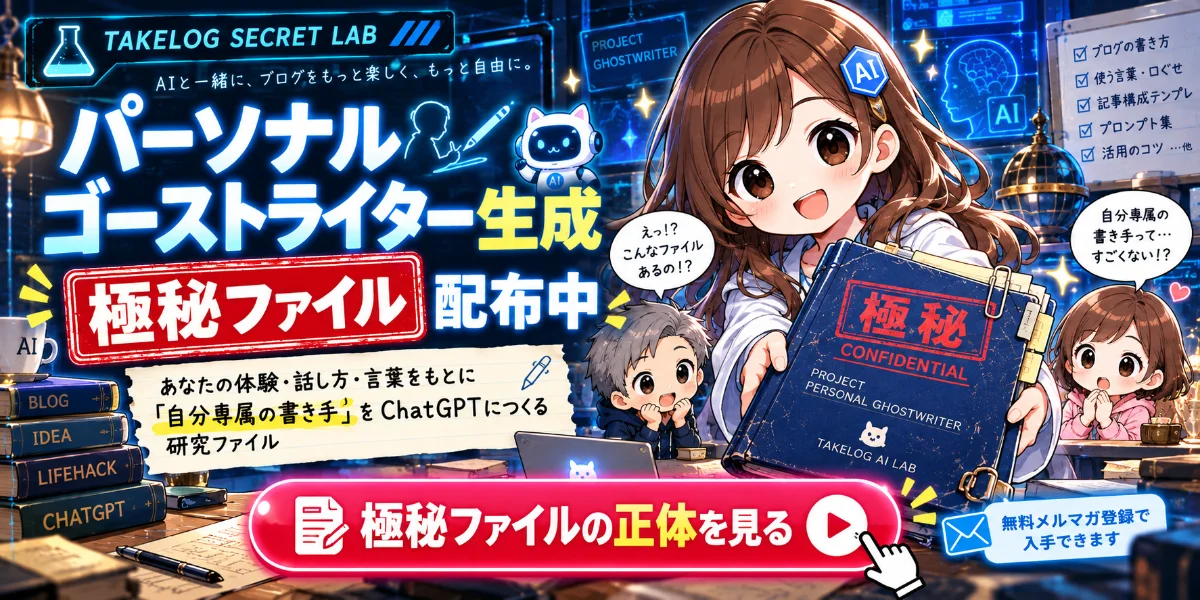
極秘ファイル配布中
あなたの体験・話し方・いつもの言葉から、
「自分専属の書き手」をChatGPTにつくる
ちょっと怪しい研究ファイルができちゃいました(笑)。
何が入っているのかは……
研究所の中でこっそり確認してください。
※無料メルマガ登録で極秘ファイルを入手できます。
怪しいですが、ちゃんと僕が作ってます(笑)。