Ever asked ChatGPT to write a blog post, read the draft, and thought:
“Wow. That sounds like a corporate robot written by a guy in a tight suit.”
Maybe you usually write like you’re talking to a friend over coffee. But suddenly, ChatGPT turns you into a corporate PR machine. Every sentence is polished, every paragraph is ridiculously stiff, and somehow you’ve become the kind of person who says, “In today’s fast-paced digital landscape.”
Wait. Who invited that guy into your blog?! (lol)
I ran into the exact same wall when I started using ChatGPT for blogging. Generating a 2,000-word article took seconds. But it had zero personality, zero real-life mistakes, and zero soul. The words were there. I wasn’t.
Eventually, I realized I had been doing the whole thing backward:
Stop asking ChatGPT to write like you before giving it a chance to actually GET TO KNOW YOU!
Here is the step-by-step process I use to turn ChatGPT from a generic, boring assistant into a Personal AI Ghostwriter that actually sounds like a real human being.
No 47-page prompt engineering degree required.
Can You Really Train ChatGPT to Write Like You?
Yes, you can—if you stop treating it like a vending machine and start treating it like a real writing partner.
Think about hiring a human ghostwriter.
Would you hand them a generic topic like “Benefits of Exercise,” disappear for three days, and expect them to deliver an autobiography that captures your exact sense of humor?
Of course not!
You’d sit down, grab a coffee, tell them your embarrassing stories, explain your weird opinions, and show them examples of how you talk. And when they handed you a bad draft, you’d say, “Hey, tone it down. I’d never say it that way.”
ChatGPT needs the exact same process.
You don’t need to be an AI genius. You just need to be a better source of raw information about yourself.
And guess what? You’ve been YOU for your entire life—you’re already 100% qualified for the job!
Step 1: Tell ChatGPT Who You Are BEFORE Asking It to Write
Let’s start with something super simple.
Instead of opening a new chat and immediately screaming “WRITE A BLOG POST!”, introduce yourself first.
Spill your background, your hobbies, your failures, and the things that make you tick. You don’t need to share private bank details or write a 500-page memoir in one prompt. Just start a normal conversation.
Use This Exact Kickoff Prompt:
“I want you to become my personal AI writing partner.
Before we write anything, I want you to actually understand who I am, what I’ve experienced, and how I think.
Ask me ONE question at a time about my interests, experiences, opinions, and writing style.
Keep the conversation completely natural and casual. Don’t invent fake details about my life.
Let’s start.”
Notice what’s missing?
No technical jargon, no 50-line commands, no demanding magic.
You’re simply inviting AI to have a normal chat.
And as you answer its questions, something awesome happens: a random question about a hobby reminds you of an embarrassing mistake you made three years ago. That mistake turns into an epic story.
Suddenly, you’ve got a killer blog post idea you didn’t even plan on writing!
Step 2: Dig Up Your Real Experiences (The Stuff Readers Care About)
Here’s a hard truth I learned after spending years collecting blogging courses, marketing manuals, and fancy tools:
Learning SEO and article structures doesn’t tell you WHAT to say.
You can study keywords and headlines until your brain melts, but readers don’t connect with keywords. They connect with your real experiences.
I love using ChatGPT to dig up stories I completely forgot about.
For example, I work a night-shift job at a hotel, but I also do delivery work (like Uber Eats) on my bike. On paper, that sounds like a dry fact about having two jobs.
But when I chatted with ChatGPT about it, the real hot takes came out:
- “Why keep the night job if delivery pays more on good days?”
- “Because I hate worrying if I’ll make rent when demand drops!”
- “Plus, dealing with self-employed taxes and health insurance was an absolute nightmare for me!”
- “And my favorite part about delivery work? I can decide NOT to do it today! (lol)”
Those raw opinions weren’t sitting inside a keyword tool. They were buried in my real life.
Prompt ChatGPT to Dig Up Your Stories:
“Based on what I’ve told you about my life, what stories or hot takes might be interesting or useful to other people?
Look for lessons, unexpected decisions, embarrassing mistakes, and moments where I did things differently.
Don’t invent fake stories. Only use what I’ve actually told you. Ask follow-up questions if you find something worth digging into.”
Now you’re not asking AI for 100 generic, soul-less blog topics. You’re finding stories that ONLY YOU can tell.
Step 3: Show ChatGPT How You ACTUALLY Talk
Telling AI to “make it friendly” doesn’t work. To a corporate marketer, “friendly” means cheerful and polite. To you, “friendly” might mean making fun of yourself, ranting about something ridiculous, and using casual slang.
Don’t use vague adjectives. Give ChatGPT real examples of your writing!
Paste in 1 or 2 old emails, blog posts, or social media rants that genuinely sound like you.
Try This Style Analysis Prompt:
“Here are examples of my actual writing.
Analyze my tone, sentence structure, paragraph length, sense of humor, vocabulary, and how I explain things.
Point out the specific habits that make my writing sound like ME. Don’t rewrite anything yet—just tell me what you notice so I can confirm or fix it.”
When it responds, tell it what it got right and what it missed!
For instance, I tell ChatGPT:
“I write like I’m talking to a friend over coffee. Do NOT make every single sentence its own line like a dramatic movie trailer, and do NOT make me sound like a fake motivational speaker!”
Even an AI ghostwriter needs a strong editor.
Step 4: Build a Reusable “Writing Profile”
ChatGPT’s memory isn’t perfect, and context windows can reset. Instead of re-explaining your whole life every time you open a new window, turn your chats into a simple Writing Profile.
Prompt ChatGPT to Generate Your Profile:
“Based on our conversations and the writing samples I shared, create my Personal Writing Profile.
Include:
- My background and real-life experiences
- My opinions and core beliefs
- My preferred tone, humor, and paragraph structure
- Words, phrases, and corporate clichés I HATE
Format it so I can copy, paste, and reuse it in future chats.”
Copy that text and save it in a simple Notepad document or PDF on your desktop.
The next time you open a fresh ChatGPT window, paste your Writing Profile right at the start. Boom—your AI ghostwriter is instantly caught up and ready to write in YOUR voice.
Step 5: Talk Through the Post BEFORE Hitting “Draft”
This is where 90% of people mess up.
Even if ChatGPT knows your voice, it doesn’t know your specific opinion on today’s topic. If you just say “Write a post about X,” it will guess your opinion—and usually guess wrong.
Talk it out first!
Use This Pre-Writing Prompt:
“I want to write an article about [YOUR TOPIC].
Before drafting, let’s talk about it. Ask me a few questions to uncover what I REALLY think, what I experienced, and what frustrated me.
Don’t assume I agree with standard advice. After we chat, suggest 3 punchy article angles based on my real answers.”
Now, ChatGPT isn’t guessing. It’s working with your raw, authentic point of view.
Step 6: Draft the Post and FIX the Robot Fluff
Now you can finally ask for the draft!
Use This Drafting Prompt:
“Based on our chat about [YOUR TOPIC], draft a blog post using my Personal Writing Profile.
Use my real stories and opinions. Keep the paragraphs connected and natural.
Do NOT invent fake stats, quotes, or achievements I didn’t mention. Make it sound like a real human conversation!”
When the draft comes back, read it out loud.
Does it sound like you? Did it turn a funny personal story into a dry textbook lesson?
If it sounds fake, CALL IT OUT!
Type:
- “Too formal! Tone it down.”
- “Put that embarrassing mistake back in—that was the funniest part!”
- “You’re making me sound like a corporate lawyer. Fix it!”
You are allowed to fight with your AI ghostwriter (lol). That’s how you get a draft you’re actually proud to put your name on!
Ready to Stop Overthinking and Build Your AI Blog?
Here’s the bottom line:
Your experiences are the fuel. Your opinions are the steering wheel. ChatGPT is just the engine.
Stop overthinking. Stop collecting courses you’ll never open.
If you want a complete, step-by-step blueprint that walks you through this exact process from scratch, check out I DID IT! AI BLOGGING.
It’s a straightforward English PDF guide designed to help you work with ChatGPT, turn your real-life experiences into blog posts, build an email list, and launch your own digital products.
- Upload the PDF directly into ChatGPT and let it guide you step-by-step.
- Zero coding, zero fancy plugins, zero monthly fees.
- Real execution over endless studying.
Get I DID IT! AI BLOGGING — $19 USD
(Instant PDF Download. One-time purchase.)
Stop staring at a blank screen. Open ChatGPT, type your first story, and get ready to say those three awesome words:
I DID IT!
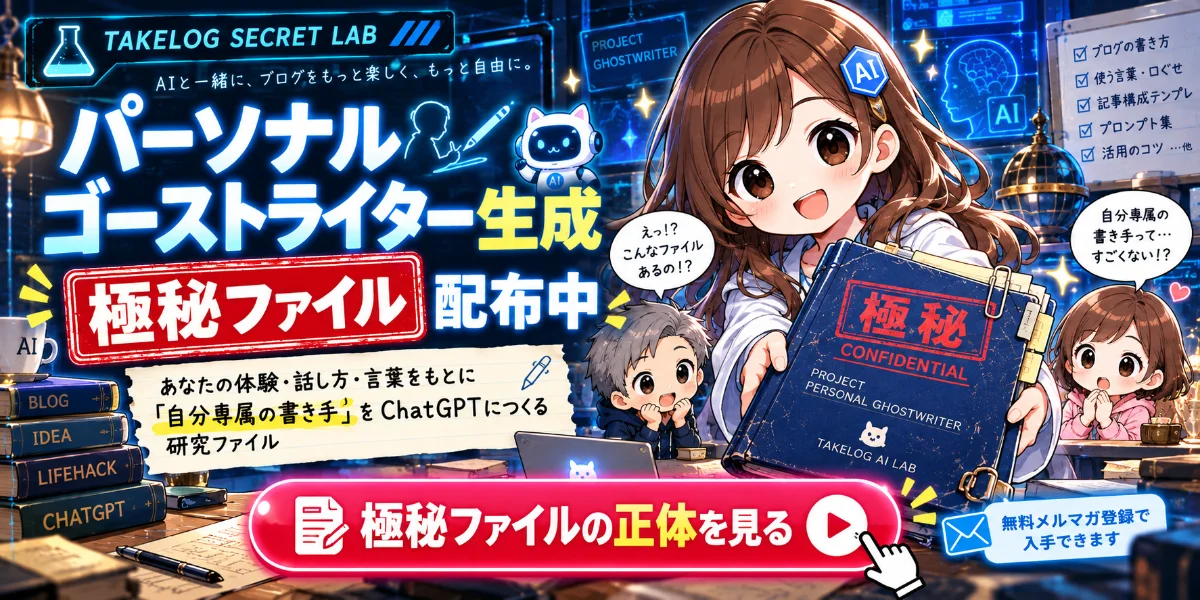
極秘ファイル配布中
あなたの体験・話し方・いつもの言葉から、
「自分専属の書き手」をChatGPTにつくる
ちょっと怪しい研究ファイルができちゃいました(笑)。
何が入っているのかは……
研究所の中でこっそり確認してください。
※無料メルマガ登録で極秘ファイルを入手できます。
怪しいですが、ちゃんと僕が作ってます(笑)。